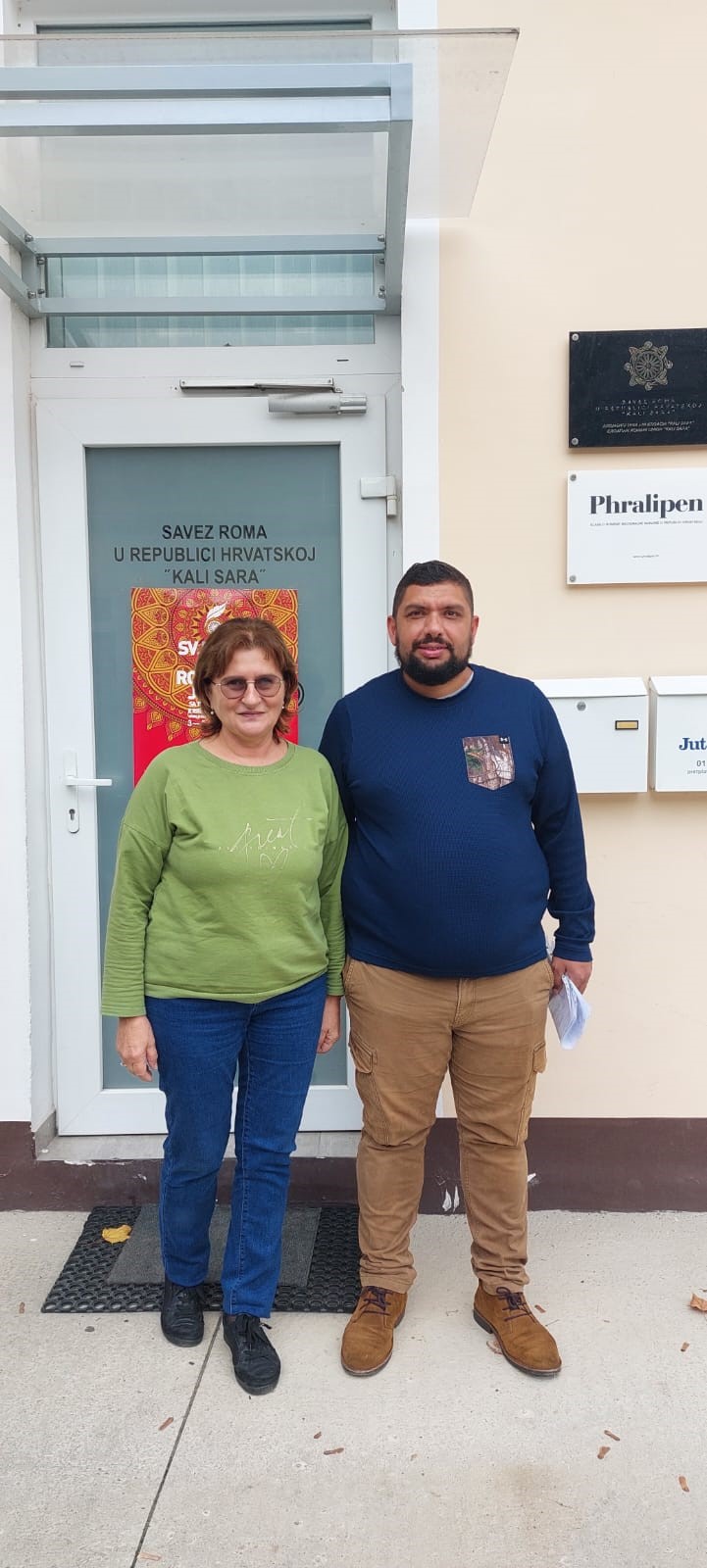
 S.B. was born on 27 November 1985 in Slavonski Brod, Republic of Croatia, but was not registered in the birth registry, nor in the citizen registry of any state. Therefore, S.B. is a stateless person and has been without any documents for years. The aggravating circumstance is that the client is a child from a Roma family, originally from the Republic of Serbia, which lived a nomadic lifestyle, and the client is therefore not registered in the citizen registry of the country of origin of his parents, nor in the country in which he was born, and has lived in the same country for more than 40 years. He is denied not only registration in the birth registry, but also education, employment, the exercise of social rights, the right to health care, the right to personal documents, the right to marry and ultimately the right to be registered as the father of his children.
The client lives in an extramarital relationship with his wife with whom he has six children, all of whom are Croatian citizens, but the client is not registered as the father of the children.
S.B. contacted our office in 2022, when he already had temporary residence, and he managed to regularize his first temporary residence in 2017, based on a statement of identity with two witnesses, because he had no other identification. Since 2017, the client has been regularly extending his temporary residence, but this is not a permanent solution, and each extension is paid for, which is a large expense for the client.
The Ministry of the Interior of the Republic of Croatia, guided by the conclusion that the client is of Serbian origin through his father, has already twice requested proof from the client that he is not registered in the Civil Registry of the Republic of Serbia, and has issued a certificate twice, the last certificate being issued on 17 January 2025.
As the client has been on temporary residence for more than 5 years (this year is the 8th temporary residence), and he also submitted a request for the regulation of long-term residence, which was rejected and has been in administrative dispute since 2022.
Since he is on long-term temporary residence, we suggested that he submit a request for the issuance of a passport based on the Convention relating to the Legal Status of Stateless Persons of 28 September 1954. He needs a travel document to further regulate his stay in the Republic of Croatia, and also for a possible visit to his brothers in Germany. On 30 October 2024 we submitted a request for the issuance of a travel document for the client in accordance with the Convention relating to the Legal Status of Stateless Persons of 1954, and also in accordance with the provisions of Article 9, paragraph 1 of the Foreigners Act (Official Gazette 133/2020), which stipulates that a travel document for stateless persons may be issued to a stateless person under the conditions set out in the Convention relating to the Status of Stateless Persons of 28 September 1954, if he or she has been granted temporary residence, long-term residence or permanent residence.
However, this request was processed for almost two years and resulted in the issuance of a special travel document for foreigners, but not in the request for the requested travel document under the Convention relating to the Status of Stateless Persons of 28 September 1954. A special travel document for a foreigner is issued to a foreigner under subsidiary protection. However, upon checking, we determined that this special travel document for a foreigner is also issued for a period of up to two years, and the foreigner was issued for the period from 4 December 2025 to 20 April 2026, i.e. for a period of 4 months, which is outside all the regulations we have looked at. Therefore, we have addressed a petition to the Ministry of the Interior of the Republic of Croatia regarding the clarification of this case.
It can be concluded that statelessness has a very negative impact on the lives of individuals because citizenship is one of the fundamental rights guaranteed by the Convention relating to the Legal Status of Stateless Persons from 1954 and the Convention on the Reduction of Statelessness from 1961, to which the Republic of Croatia is a signatory. Citizenship enables an individual to fully participate in society and represents the foundation or basis for the exercise of fundamental rights, such as the right to personal documents, the right to education, the right to work, rights from the social welfare system, the right to health care, the right to marry, etc.
Croatian laws and regulations recognize the term “stateless person”, but no special procedure has been established for determining statelessness, and such persons remain without the legal protection they are entitled to under the 1954 Convention. Statelessness in the Republic of Croatia can be determined through the procedure for granting residence (temporary, permanent) and during the procedure for regulating Croatian citizenship or during the application for granting asylum, however, there are no uniform guidelines on the method of submitting an application, both for applicants and for the bodies that make decisions on applications. Stateless persons can exercise the right to travel documents, and other rights are exercised depending on the type of residence permit. Therefore, there is no single law in Croatia, but the issue is regulated through UN conventions and individual laws, including the Foreigners Act, which is not adequate.
Stateless persons live in Croatia, as well as those at risk of losing citizenship, however, their identity is often not established, and these persons face difficulties in claiming their rights, have almost no protection, and are not included in the vulnerable group of citizens in order to enjoy a certain status on that basis.
Finally, we would like to point out that stateless persons are legally invisible because no state considers them a citizen, thus denying them access to basic human rights. Legal invisibility makes it impossible for them to prove their identity, so they do not have identification documents, and they also face the impossibility of access to education, health care, employment, social welfare, and marriage. According to UNHCR, there are several million such persons in the world, whose rights are protected by international conventions from 1954 and 1961.
In Sisak, 27 January 2026


 Loading ...